 SinMirror
A little self-reflection. A lot to discover.
7 Deadly Sins
TestAn independent IDRlabs alternative
Nobody is just one thing.
Discover your seven-sided self.
SinMirror is a free 7 deadly sins test website with 28 original questions, seven scores, and share cards. Answer for the last 30 days to discover your original two-trait profile.
An independent test website for entertainment and self-reflection. Not a diagnosis. Not affiliated with IDRlabs.
The Gilded Dragon
A little ambition. A taste for more.
Take the 7 Deadly Sins Test Online
About 3 minutes · No sign-up · Your answers stay on this device
A closer look, in three steps
How the 7 deadly sins quiz works
Your everyday habits are more interesting than a good-or-bad label.
Think about the last month.
Respond to 28 original statements with what feels true, not what sounds impressive. There is no countdown and no perfect score.
See your full spectrum.
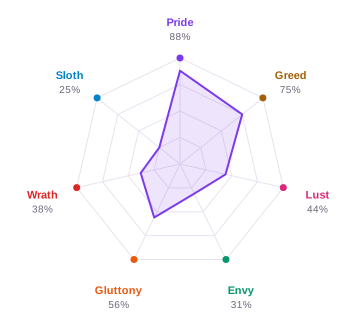
Get seven transparent scores and a two-trait archetype. A radar chart shows the shape of your answers, not how you rank against other people.
Keep the insight. Share the card.
Choose one small challenge for the week. Download your result, share a link, or keep it entirely to yourself.
An old idea. An everyday lens.
Explore the seven deadly sins
Not villains. Not verdicts. Patterns we can notice, question, and redirect.
Pride
When being seen becomes being right.
Meet its counterpart: HumilityIIGreed
Enough keeps moving a little further away.
Meet its counterpart: GenerosityIIILust
You follow the spark.
Meet its counterpart: Self-controlIVEnvy
Someone else’s highlight becomes your measuring stick.
Meet its counterpart: KindnessVGluttony
The hardest part is stopping at enough.
Meet its counterpart: TemperanceVIWrath
A small spark can occupy a whole day.
Meet its counterpart: PatienceVIISloth
You know the next step. Starting is the hard part.
Meet its counterpart: DiligenceBehind the mirror
What is the 7 deadly sins test?
The 7 deadly sins test is an entertainment questionnaire about pride, greed, lust, envy, gluttony, wrath, and sloth. SinMirror uses 28 original statements to give each trait a score from 0 to 100. Your two highest scores form an archetype, with special results for low or balanced profiles.
The seven deadly sins began as a religious framework for thinking about recurring temptations. This quiz borrows that familiar vocabulary as a prompt for everyday reflection, not as a declaration about your faith or character. You do not need to be religious to notice when comparison gets under your skin, a small inconvenience becomes a big mood, or a five-minute task follows you around for a week. For the historical idea of “capital” sins as patterns that can lead to other wrongs, see Aquinas, Summa Theologiae, I–II, question 84. That theological source is background, not scientific validation of this quiz.
Each of the seven traits describes a different pull. Pride can show up as a need to stay impressive. Greed can appear as a fear of having less. Lust is represented here by the pull of attraction and newness. Envy focuses on comparison. Gluttony concerns the difficulty of stopping at enough, not only eating. Wrath concerns anger and grudges. Sloth concerns avoidance and the gap between intention and action.
None of these categories can capture a whole person. The same answer can also have very different explanations. A person might hesitate to lend something because it is irreplaceable, put off work because they are exhausted, or feel sensitive to correction after a difficult week. A questionnaire cannot identify those causes. It can only give you a structured place to start asking questions.
How this test website works
Think about your last 30 days rather than the best or worst moment of your life. Each statement has five responses, from “Not me at all” to “Very me.” Pick the answer that fits most often. The test advances after a short pause, and you can use Previous to change an earlier answer. On a keyboard, number keys 1–5 select a response and the left arrow goes back.
Unfinished answers are saved in this browser when local storage is available. That means you can close the page and come back on the same device. Private browsing, cleared storage, a different browser, or blocked storage can prevent a resume. The score calculation itself happens in your browser; there is no account to create or email address to hand over.
How the 7 deadly sins test is scored
There are four statements for each trait, including one reverse-scored statement. A normal response keeps its value from one to five. A reversed response becomes six minus that value. Add the four values, subtract four, divide by sixteen, and multiply by one hundred. Round to the nearest whole number. That is the score shown on your chart.
A score of 75 does not mean you are more sinful than 75 percent of people. We do not have a representative reference sample, and the test does not produce percentiles. The number describes where your answers fall within this questionnaire’s possible range. Read the full scoring method for examples, intensity bands, tie handling, and the limits of a four-statement scale.
What your seven-sin result means
Your result is a seven-dimensional snapshot rather than a single label. We combine the top two traits into one of 21 playful archetypes, such as The Gilded Dragon for pride and greed or The Daydreamer for lust and sloth. The names are storytelling devices. They are not psychological types established by research.
If all seven scores fall below 25, you receive The Quiet Saint. If the highest and lowest scores are within ten points, you receive The Balanced Pilgrim, unless the all-low rule applies first. These names are not achievements or diagnoses. Closely grouped high scores and closely grouped middle scores can both produce a balanced result, so always read the chart alongside the headline.
The result page also includes an opposite virtue and a one-week challenge. Rather than attempting a personality overhaul, try one small experiment: wait before sending an angry message, celebrate someone without comparing, or begin a task for two minutes. Notice what happens and keep whatever helps. You can explore the archetype library without taking the quiz.
The seven deadly sins and their virtues
The traditional pairing of a sin with a virtue offers a useful second question: what could I practice instead? Humility invites a more realistic view of the self. Generosity makes room for giving. Self-control creates a pause before following an impulse. Kindness redirects comparison toward care. Temperance asks what enough looks like. Patience creates room between anger and action. Diligence turns intention into a manageable next step.
These are broad reflection prompts, not prescriptions. Rest is not a failure of diligence, appetite is not evidence of bad character, and anger can be an appropriate response to mistreatment. If a result seems unhelpful, discard the label and focus on your actual circumstances. Persistent distress or difficulty with daily life deserves support beyond an online quiz.
A few things worth knowing
7 deadly sins test questions, answered
What is the 7 deadly sins test?
It is a free, original self-reflection quiz about pride, greed, lust, envy, gluttony, wrath, and sloth. Answer 28 statements about the last 30 days to receive seven scores from 0 to 100 and a playful two-trait archetype. It is entertainment, not a psychological diagnosis or a measure of moral worth.
Is this the official IDRlabs 7 Deadly Sins Test?
No. SinMirror is an independent alternative to the IDRlabs 7 Deadly Sins Test, not an official version. We are not affiliated with, endorsed by, or operated by IDRlabs. Our 28 questions, scoring explanations, and archetypes are original. This website uses its own questionnaire and transparent scoring method.
How long does it take?
Most people can work through 28 short statements in about three minutes, but there is no timer. Take as long as you need. You can return to earlier answers, and unfinished progress is saved in this browser when local storage is available.
Is the test free, and do I need an account?
The entire test, all seven scores, the result explanation, and downloadable share cards are free. There is no account, email requirement, or payment step.
Are the results scientifically validated?
No. This is an original entertainment questionnaire, not a standardized or clinically validated instrument. Scores summarize the answers you gave using a transparent formula. They do not establish a personality disorder, predict behavior, or replace professional advice.
What if my scores are tied?
When the top two scores differ by three points or less, we show a tie message. The archetype combines two traits rather than pretending that one score explains everything. Very low and closely balanced profiles also have their own result names.
Are my answers private?
Individual answers remain in your browser; they are not included in a shared result link. The link does contain all seven scores, so anyone you send it to can read that profile. Hosting providers necessarily process ordinary request information. Read the privacy page for the details.
Can my result change?
Yes. Your answers may change with circumstances, energy, relationships, or a different reading of a statement. Answer for the last 30 days and treat your result as a snapshot, not a permanent identity.
Keep looking inward
Understand your test results and virtues
The field notes
Read your result without the judgment
What the numbers say—and what they cannot tell you.
The field notes
From impulse to everyday practice
A useful counterpart for each familiar pattern.
The field notes
No mystery behind the numbers
Our original questionnaire and complete scoring method.